Monday, May 4, 2009

Thomas Kinkade Signature Gallery opens at Gallery One


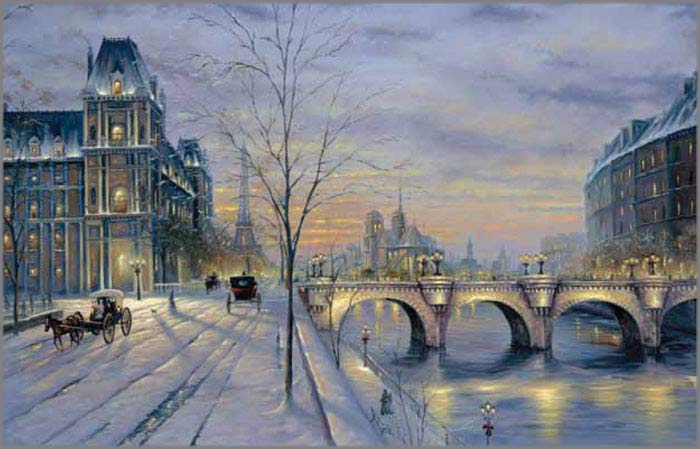
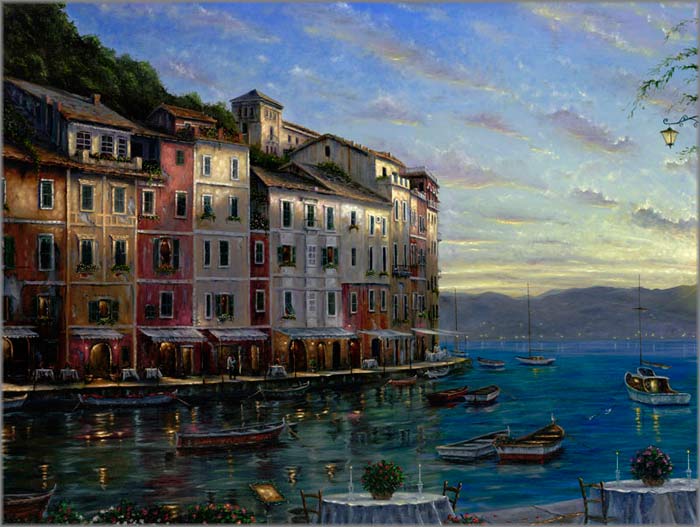
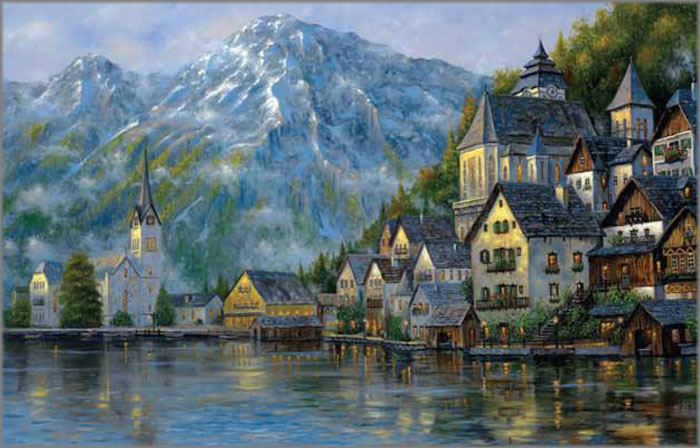
They say that Thomas Kinkade is America's most collected living artist. Whether you like his work or not, it is for sure that you know his name and recognize his images when you see them. Coming from a modest background, Kinkade has made a career of emphasizing simple pleasures and life-affirming values through his art. And whether his work is your cup of tea or not, you certainly can appreciate his talents for art and for art marketing.

While some artists are understandably resentful of his presence on the art scene, others are grateful that he has made collecting art and decorating with art comfortable and easy for both the sophisticated collector and the new collector. That new collector often finds an easy comfort in Kinkade's images of idyllic scenes and down to earth values. From there, some new collectors become obsessed with Thom's works. Others, having made their first forays into the art world, gain the confidence to purchase the works of other talented painters.

So I say hip, hip, hooray for Mr. Kinkade. And it is with our appreciation to him for his fine works that we now dedicate close to 2000 square feet of our 18,000 square feet to Thom and his canvas and paper prints. (Additional space has been reserved for Kinkade framing and frame warehousing.) And we say thank you to Thom and his great staff for proclaiming that we are now an official Thomas Kinkade Signature Gallery.

Why is that important to collectors? Now, as the largest Thomas Kinkade Signature Gallery east of the Mississippi, Gallery One now offers Plein Airs, Robert Girrards, Brushworks, Classics, Inspirationals, Miniatures, Bronzes, Disney Dreams, Indy 500s, Nascars, Cafe Collection, Nightlights, Impressions of Israel PLUS Examination Proofs, Gallery Proofs, Publisher’s Proofs, Renaissance Editions, Studio Proofs and more.

We hope you will visit us soon...in person or on the web...to shop for works by Thom and by our other outstanding artists.

As always, we want to be your favorite place to shop for art. Forever!

That's all for now.

Norah Lynne

Friday, April 3, 2009

Answering your questions...

Dear Gallery One: How can you call a print an original? Aren't all prints just reproductions? JP, UTAH

Dear JP:

We get lots of questions about how prints are made and why we sometimes refer to a print as an original. It is easy to understand the word "original" when speaking of paintings, pencil drawings, pen and inks, acrylics, watercolors, etc. Here the artist has created ONE work of art with his own hand. The surface might be paper or canvas or even masonite. I like to call these SINGULAR ORIGINALS.

A bit more complicated are MULTIPLE ORIGINALS....commonly called ORIGINAL PRINTS. Traditionally, the artist creates a master image for the purpose of making a small number of prints that he might sign and number. The master image could be created upon a block, stone, plate or screen — any of which assists in conveying the image to the print surface.

Here are examples:

SERIGRAPHY or SILKSCREEN: A stencil is prepared (usually upon a silk or polyester surface) and ink is forced through openings in order to produce the desired image. For some complicated prints, dozens of screens might be used to produce the desired colors. (Image at left is a Charles Harper serigraph or silkscreen.)

ETCHING: A technique for making prints in which the artist works upon a metal plate that has been covered with an acid-resistant material through which he develops his design by exposing portions of the metal plate. This prepared plate is then immersed in an acid bath; the acid eats through the plate where the acid-resistant material has been removed; the plate is then removed from the acid bath and cleaned leaving an incised plate with lines that can hold ink for transfer to paper. (Etchings are often hand-colored.)

RELIEF PRINTING: A block or plate is cut out so the desired image stands in relief. That projecting block or plate is inked and it is used like a stamp to transfer the image onto paper or another substrate. (You probably made your own relief prints in kindergarten using a potato.)

LITHOGRAPHY: The artist draws his design upon a plate or stone which is moistened with water. Ink is then applied and paper is pressed on to the surface to pick up the design. Modern adaptation includes the use of mylar to replace the plate or stone. (The printed image will be in one color. A "colored" lithograph is prepared by the artist using multiple plates or stones...or by hand coloring the print.) (Image at left is an original lithograph by Edna Hibel.)

The blocks, plates, stones and screens cannot be considered originals. They are just vehicles to produce ORIGINAL PRINTS. And you can appreciate the individuality of the original prints...especially when they have been hand-colored or produced with multiple plates, stones or screens.

You'll find original prints at www.galleryone.com by Bateman, Brenders, Christensen, Doolittle, Hibel and others. When we have finished refining our website, you'll be able to search for them all by typing "lithograph," for example, into our search box.

Then there are REPRODUCTIVE PRINTS. The artist produces an original work...and photographic technology and automated printing equipment create reproductions of that original. Fine art print reproductions are often signed and numbered in limited editions.

In any case, care should be exercised so that prints remain in mint condition for maximum value and enjoyment.

A similar, but much advanced process, creates giclĂ©es — the state of the art prints now taking the art collecting world to a whole new level. We get lots of questions about giclees. How to pronounce the word? And what does it mean? We will cover this in a later blog.

That's all for now.
Norah Lynne

PS....Email us at art@galleryone.com with your questions and/or comments. We'll try to address them all either in the blog or person-to-person.

Thursday, March 5, 2009

All About Masterworks in Miniature 2009

After the Ballet by Jane Mihalik
One Lucky Guy by Alan Bean
Our famed annual Masterworks in Miniature runs March 6 - March 21. Now in its 18th big year, the international art event features original works by Robert Bateman, Alan Bean, Carl Brenders, James Christensen, Guy Coheleach, Bev Doolittle, Scott Gustafson, Edna Hibel, Terry Isaac, Dean Morrissey, Liz Lemon Swindle, Charles Wysocki and others — to name-drop a few. Most works will be priced from $350 to $5000. Appropriate custom framing is included.

An especially “out of this world” image is the work of astronaut/artist Alan Bean whose image “One Lucky Guy” was created with the use of “lunar tools” and remnants of moon dust.

Each miniature is equally special and demand dictates that prospective buyers from throughout the world submit ‘intent-to-purchase’ forms in hopes of ‘being drawn’ to buy their favorites.

All the information is on our website: www.galleryone.com

Intents can be filed by mail or over the web where the entire collection can be viewed. Of course the miniatures are all on display at Gallery One in Mentor OH.

While some Masterworks will fit in the palm of one's hand, others are as large as 9" x 12." A rare few may be a bit larger. Regardless of size, all are exquisitely detailed and represent the high quality expected of the individual artists. Genres include wildlife, portraits, still life, landscape, abstract and fantasy.

Just for fun...here are some facts about Masterworks 2009!

1. Four of the artists have not signed their images. They forgot! After Masterworks, these works will be returned to the artists for signatures. (You may be able to spot these on our website...or if you tour the exhibition in person!)
2. The average price of a Masterworks is $1700.
3. The lowest priced Masterwork is $275.
4. Sixty-two Masterworks are under $1000.
5. Ninety-two Masterworks are under $1500.
6. Brochure price is wrong on Alan Bean’s “One Lucky Guy.”
Correct price is $16925

A new feature of Masterworks is a collection of Masterworks EXTRAS....more than 100 works that can be purchased now without waiting for the drawing.

Hope you'll visit us on the web...or in person. You'll love this event...the biggest little show in the world!

That's all for now.
Norah Lynne Brown


Wednesday, February 18, 2009

Understanding our rating system:

GUIDE to PRINT CONDITION for www.artauction.galleryone.com AUCTION BIDDERS

Before posting prints on artauction.galleryone.com, our curators examine each item (front, back, image and margins) and assign a rating. (And I have to tell you, our eagle-eyed curators are the strictest in the business.)

Prints are sorted into FOUR categories: MINT, NEARLY MINT, AS IS and UNSALEABLE.

MINT ITEMS ARE PERFECT. No blemishes. No discolorations. These prints and posters look as though they are being offered for sale for the first time...despite their ages. (Some are 35 years old!)

NEARLY MINT ITEMS WILL LOOK MINT WHEN FRAMED. For example, a poster might have some slight handling marks (usually from the artist signing process)...but those will vanish when the poster (as is traditional) is dry-mounted during the framing process. A print might have a slightly bent corner, but when matted, it will look mint. The image of a NEARLY MINT item will look brand new after appropriate framing. And, in fact, many conservators would have categorized these items as mint!

AS IS ITEMS SHOW WEAR AND TEAR. These blemishes may not be visible after appropriate framing. Some of the wear and tear is directly related to the age of the item. Other wear and tear may have occurred during transit or storage. Examples:

Acid burns from storage in or with acidic materials including envelopes, printed information (like COAs)
(if burns are confined to back of print or to margin areas, such may not be visible after framing)
Evidence of handling in the form of impressions in the paper
(most such impressions can be minimized by our staff...and may not be visible when print is framed.
Evidence of hinging with water soluble paste.

NOTE: We see the “as is” category most often when examining prints that were purchased and stored improperly by a collector. Back in the late 1970s and early 1980s when collecting limited editions first became popular, you could purchase prints by emerging artists (like Bateman and Doolittle) for $100 to $250. If your print was framed with acid-free materials by a knowledgeable framer...and hung appropriately...chances are good that your print is still in excellent condition.

If you stowed your print long-term...in its acidic envelope...or left your acidic sales receipt against the print...or stored your print where it was subject to temperature extremes and/or to uncontrolled humidity...or if you handled your print improperly...you probably have an “as is” print today. Many of those early prints are now sought after by collectors who will pay thousands of dollars for a mint print. ...and less for one in poor condition!

UNSALEABLE ITEMS ARE RETURNED TO THE OWNER OR DISCARDED. Owner should consult a restorations expert. Examples:

Severe acid burns that intrude into the image.
Suspected mold or mildew.
Noticeable printer flaws in the image.
Noticeable creases in the image.
Soiled items.
Image is faded or discolored.
Item previously framed — not in accordance with Gallery One’s conservation standards.
Noticeable damage from moisture.
Image is torn or punctured.
Item has been permanently affixed to a backing (i.e. glued or dry-mounted).
Margin has been trimmed or torn.


LONG-TERM STORAGE SUGGESTIONS:
We suggest that long-term storage be handled by placing each print separately between two full sheets of 100% white rag board. Envelopes and other paperwork should be stored outside such packaging. Each “board” package should have title, artist and date of purchase written on the outside of the rag board in pencil. You can pay your art gallery to prepare your items thusly for storage.

These “packages” should be stored flat in an area that has controlled heat/air conditioning and humidity until you are ready to frame the items. Or ask your art gallery to store the items for you until you are ready to frame them.

A good resource is www.aic.stanford.edu/library/online/brochures/paper.html

WHY IS CONDITION IMPORTANT?
Let’s say you are interested in a Robert Bateman ground hog. And let’s it was released in an edition of 950...each identical looking and each signed and numbered. And let’s say you have the choice of getting a mint condition Bateman ground hog...or a Bateman ground hog print with a damaged margin. And let’s say you can purchase either one for $200.

Which one would you want?

Now let’s change the situation. Let’s pretend that the mint condition print is $200 and the one with the damaged margin is $100. Which one would you want?

Let’s change the situation again. There are NO ground hog prints for sale in mint condition.

What are you going to do now??????

www.galleryone.com VS www.artauction.galleryone.com

Unless otherwise noted, galleryone.com and Gallery One, Mentor OH sell only mint condition prints. That’s been the Gallery One tradition since 1974!

Our auction site, http://www.artauction.galleryone.com/ sells MINT, NEARLY MINT and AS IS items — all at auction prices. Condition is clearly indicated.

Our auction reserves have taken condition into account.

Visit artauction.galleryone.com and look at each auction item. Click the image for more information. And click again to expand the image. Take a look at the notes about condition. We have calculated our reserve prices to take rarity, availability and condition into account. And you should take these same factors into account when raising your bid.

And if you want to bid, click the BID2BUY button and fill out your bid form...taking condition into account when raising your bid.

That's all for now!
Norah Lynne Brown

Friday, January 30, 2009

All about www.artauction.galleryone.com

Well, it is finally here! Our very own dedicated ART AUCTION site. And I bet it will be a favorite with new and experienced collectors. I hope you’ll visit our auction site at www.artauction.galleryone.com. But before you do, here are some things that might interest you.

This is a real art auction site...supervised by a REAL live auctioneer... not a sham auction site like most that you will find on the web.

Our auctioneer is Alan Brown, Gallery One president. He has been a licensed auctioneer for nearly 30 years. A graduate of the Mendenhall Auction School and The Certified Auctioneers Institute (University of Indiana), he oversees Gallery One’s auctions in accordance with auction law and the National Auctioneers Code. He is doubly licensed and bonded for your protection. Ohio (#62-93-6363) and Florida (AU2937).

Alan’s auction history is impressive. He has successfully raised hundreds of thousands of dollars for non-profit organizations, officiated at hundreds of Gallery One auctions - live and on the web - and he has successfully auctioned real estate in Ohio and Florida.

For his weekly web auction format, Alan mandated that hundreds of works of art ---- resales, overstocks, as is items and special buys ---- be offered at unbelievably low reserve prices. He expects that even with enthusiastic bidding, great bargains will go to savvy bidders.

After the items were selected for auction, Alan asked our curators to examine and rate each work. (And I have to tell you, our curators are the strictest in the business.)

They were asked to rate each item MINT (perfect), NEARLY MINT or AS IS.

A mint item, according to our curators, looks brand new...front, back and margins.

A nearly mint item will look mint when framed. For example, a poster might have some slight handling marks...but those will vanish when the poster (as is traditional) is dry-mounted during the framing process. A print might have a slightly bent corner, but when matted, it will look mint.

An as-is item will have some blemishes that may (only if you have an eagle eye) be visible after framing.

Reserve prices have taken condition into account. And you should take condition into account when raising your bid.

So take a look at each auction item. Click the image for more information. And click again to expand the image. And if you want to bid, click the BID2BUY button and fill out your bid form.

I think you’re going to like our new site....but please let us hear from you with your questions, comments and suggestions.

That's all for now.

Norah Lynne Brown, VP

Saturday, January 17, 2009

Remembering Andrew Wyeth

Andrew Wyeth, the renowned American painter, died January 16, 2009. The photo at left shows the famed artist with President Bush as he receives the 2007 National Medal of Arts.

The art community is mourning the death of a legend.

Andrew Newell Wyeth (born July 12, 1917)was primarily a realist painter. He was sometimes referred to as the "Painter of the People," due to his work's popularity with an adoring American public.

He was the son of the illustrator and artist N. C. Wyeth, the brother of inventor Nathaniel Wyeth and artist Henriette Wyeth (Peter) Hurd and the father of artist Jamie Wyeth and Nicholas Wyeth.

Wyeth's favorite subjects were the land and people around him - both in his hometown of Chadds Ford PA and at his summer home in Cushing ME.

One of the most well-known images in 20th Century American art is his painting, Christina's World, currently in the collection of the Museum of Modern Art in New York City.

Blog Flux Local - Ohio
GetBlogs Blog Directory
Add to Technorati Favorites

Saturday, January 10, 2009

Remembering Greg Clair

Last evening we learned of the passing of another friend, noted wildlife artist, Gregory Clair, who died January 8, 2009 in Scottsdale AZ. He was 54. Our thoughts are with his family at this difficult time.

Gregory Clair`s experience in the outdoors began early as he accompanied his father hunting upland birds in Ohio and Michigan. Greg later studied and painted wildlife, entering his first art competition in 1989...the 1990 Ohio Wetlands Stamp Contest. He was a semifinalist.

The next year he won the Ohio contest. Over the next 17 years, he received many honors and worked with and donated to Ducks Unlimited, Pheasants Forever, National Wild Turkey Federation, Quail Unlimited, Ruffed Grouse Society and Rocky Mountain Elk Foundation. His base was Bowling Green OH and later, Scottsdale.

"Whenever I am in the out-of-doors I am awed at the diversity and intricacy of God`s magnificent creation," he said. "I hope to evoke similar emotions in those who view my art."

Among Greg's accomplishments:
1991 Ohio Duck Stamp winner
1999 Ohio Ducks Unlimited Sponsor Artist
2002 Ohio Ducks Unlimited Artist of the Year
2004 Federal Duck Stamp Contest, fourth place
2005 Ohio Ducks Unlimited Sponsor Artist
2006 Ohio Duck Stamp winner
2006 Ohio Magazine's Ohioan of the Month
2007 Ohio Ducks Unlimited Artist of the Year
2007 Ohio Ducks Unlimited Sponsor Artist
2007 Buckmasters Print of the Year
2007 Featured Print South Carolina Waterfowl Assoc.

Greg was a regular contributor to Gallery One's annual Masterworks in Miniature event and was a featured Gallery One artist.